 Catahoula
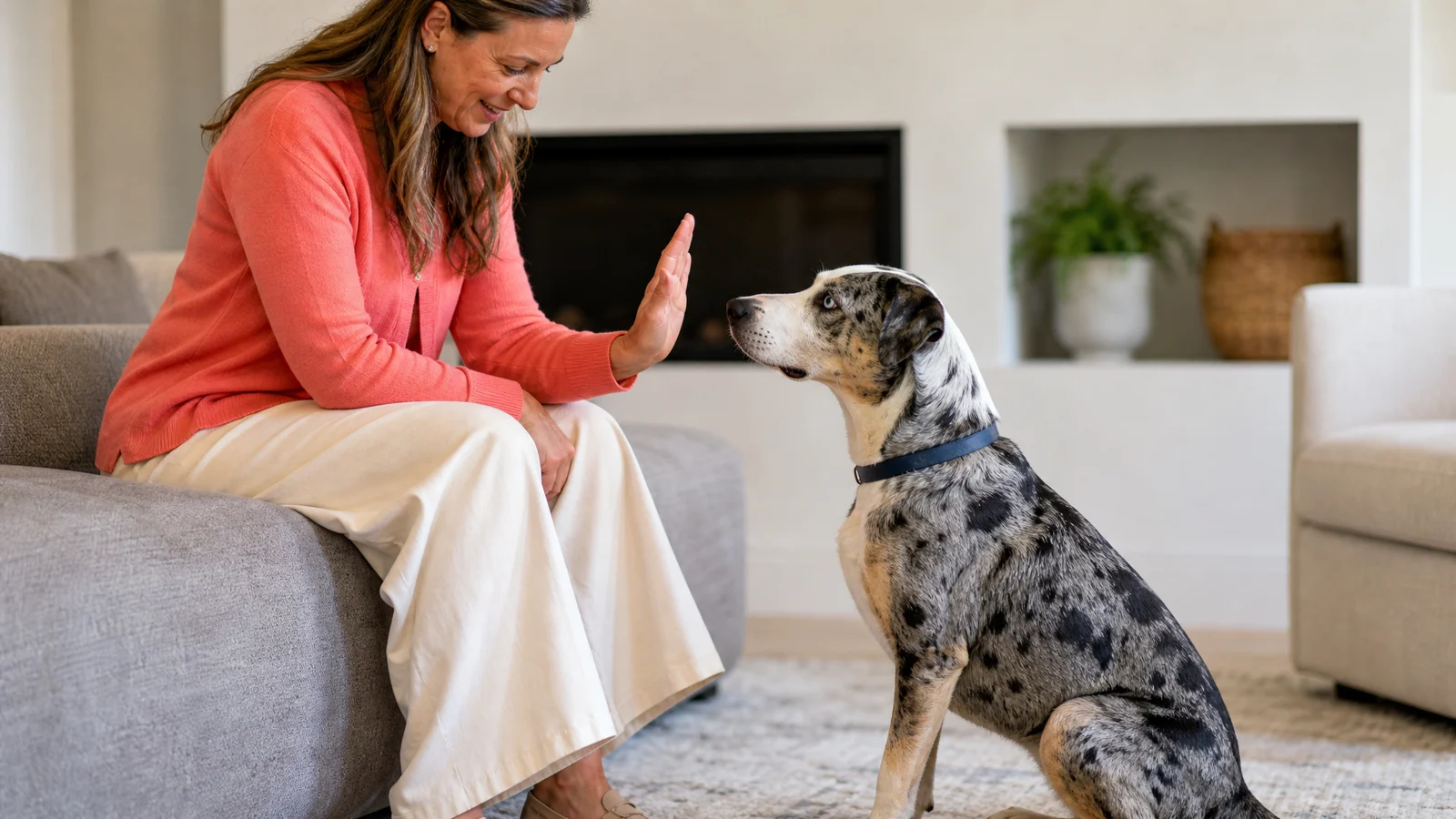
Ordinary dog advice leans on your voice: a cheerful yes to mark the right moment, a name to get attention, a recall call across the yard. For a deaf merle Catahoula Leopard Dog, the verbal marker, the recall call and the attention cue all become visual or touch-based, while the rewards, the exercise and the patience stay just as they were.
That shift matters here because Catahoulas are independent and watchful. A dog who cannot hear a knock or a stranger at the fence needs a clear visual language to lean on.
Without it, they will invent their own answers. Read on for how to set up your space, earn eye contact, use a gentle touch, pair each signal with a reward, add a visual marker and take it all outdoors safely, starting with sit, down and come.
Setting Up Hand Signals for a Deaf Merle
Stage one is setup, and it asks less of you than you might fear. A deaf Catahoula learns the way a hearing one does, by noticing what earns a reward and repeating it, and the AKC-style trait ratings put trainability at 4 of 5.
Only the channel changes. We have trained this breed for many years, and the dogs who settle in fastest have owners who make the visual world calm and clear before any teaching starts.
Choosing the Room
Pick a quiet, well-lit room and close the door. Your hands are now your voice, and your dog must see them clearly.
Energy is rated 5 of 5 for this breed, and a dog who has not had a good run will not sit still for lessons, so exercise first and teach second. Keep other pets and busy foot traffic out for now.
Gathering Your Kit
Have these ready before you call your dog over. Set them out before the first repetition: Preparation keeps the lesson quiet.
- Small, soft treats in a pouch, tiny enough that each repetition stays quick and your dog stays eager.
- A thumbs-up or a small flashlight, which will become the visual marker in stage four.
- A short list of first signals, taught in this order: attention, sit, down and come.
One more piece of preparation belongs at the front door, because a deaf dog gets no warning from a doorbell or footsteps. Many Catahoulas treat a visitor as family once the owners have clearly welcomed that person, even when the first greeting is rough, so your calm, visible welcome counts for more than the visitor's own friendliness.
This is general information, not medical advice. Check with your veterinarian to confirm your dog's hearing and to ask about anything health related, and keep regular checkups on the calendar.
Eye Contact Before Hand Signals for a Deaf Merle
Every signal depends on your dog looking at you when you give it. A hearing dog can be called from across the room, but a deaf dog has to be watching before the conversation can even begin, so eye contact is the base that every later stage rests on.
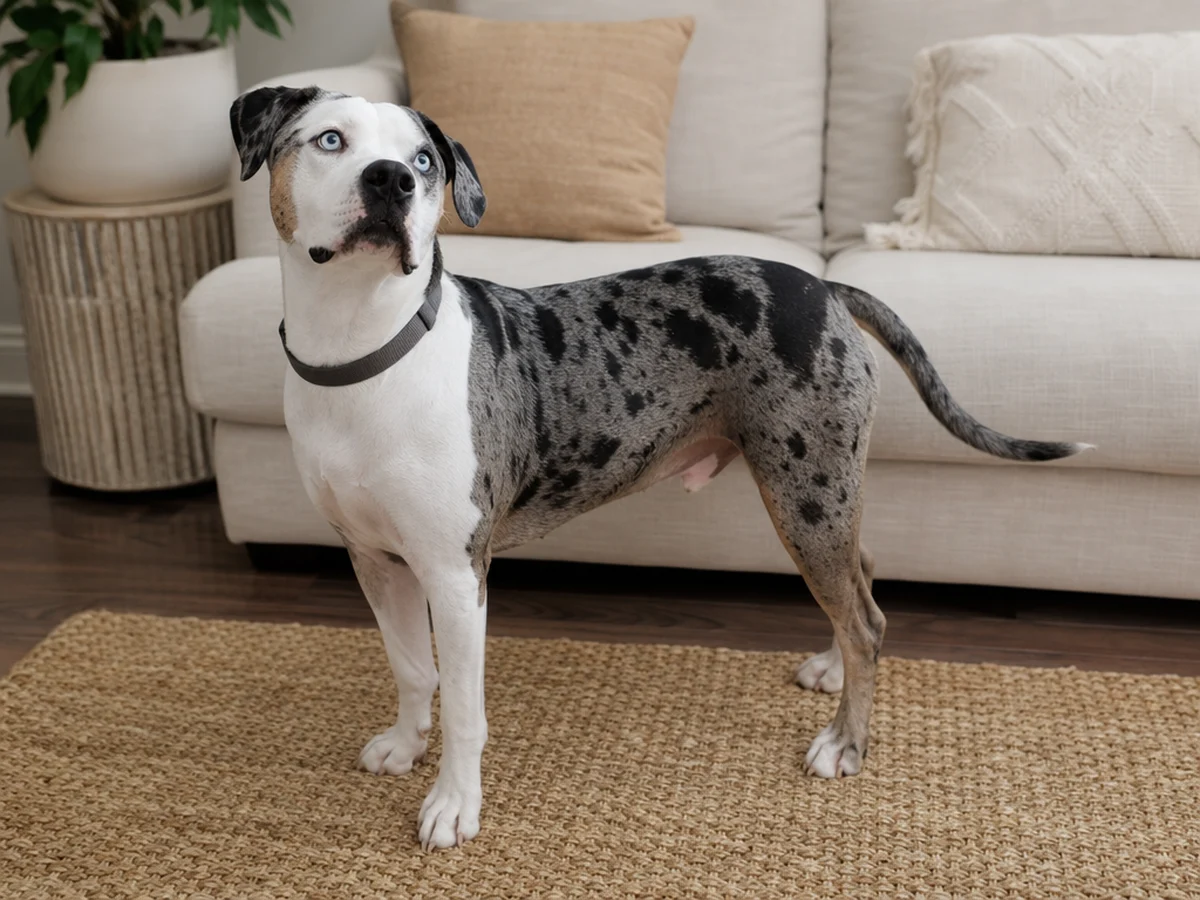
The good news is that you never have to ask for it. You notice it, reward it, and let your dog work out that looking your way pays.
Waiting for the First Look
Sit or stand in the quiet room with treats ready and say nothing, since there is nothing to say. Stay still and let your curious Catahoula take in the room.
Sooner or later their eyes will find your face, and at that instant you deliver a treat beside your eyes so the look and the reward stay joined. Skip the waving and tapping. A dog who chooses to look has learned more than one who was invited to.
Rewarding Each Glance
Reward every look at first, even a flicker. Then step sideways or drift to another part of the room.
Your dog learns that looking back works anywhere, not only when you stand still. If they stare at the treat hand, bring the reward up to your eyes before you hand it over, and wait a beat longer each round.
Many owners see a Catahoula who is attentive indoors and acts as if the owner has vanished outside, so expect to rebuild this habit in every new place. Finish before attention drifts, leaving your dog ready for the next round for more, because a dog who checks in on their own is already halfway to every signal.
Can Touch Get a Deaf Catahoula Leopard Dog's Attention?
Yes, and it often becomes the most-used tool you have, as long as the touch is always the same and never a surprise. Eye contact only works if your dog is already looking, so you need a polite way to ask them to turn toward you.
Step into their line of sight first, then touch the shoulder or side with an open, soft hand, in the same spot with the same light pressure every time. The instant they turn, give a treat.
Building Comfort in Layers
Begin when your dog is awake and relaxed: touch, treat, repeat, until the touch brings an eager look instead of a flinch. Then try other angles, always where they can see you coming.
Watch for stress signals such as lip licking, a pursed mouth or yawning, and if you see them, go back to an easier step. Rushing here costs more than it saves.
Avoiding Surprise Contact
Sleeping dogs deserve special care. Let a treat held near the nose do the waking where you can, and ask everyone in the house to use the identical touch so your dog gets one message from all of you.
This breed asserts themselves when they feel mistreated, so a sudden grab from a visitor can sour the whole idea of touch. Young children should practice only with an adult beside them.
You will see advice to stamp on the floor or wave both arms to get a deaf dog's attention. A calm, predictable cue works better, because a watchful Catahoula does best when nothing about you is startling. One touch, one spot, one message.
Pairing Hand Signals for a Deaf Merle With Rewards
Stage three joins the pieces, and the order never changes. Give the signal, wait for the response, and deliver the treat right away.
Teach a single signal per session block and add the next only once your dog gets the first right in several spots around the house. A signal that always means the same thing gives an independent dog cues worth following.
Shaping the Signal
For sit, hold a treat in your closed hand at your dog's nose and sweep it up and back over the head. As their bottom lowers, release the treat.
Down grows out of sit, with the lure traveling toward the floor between the front paws. Make the two hand shapes look clearly different, because a deaf dog reads your whole body and look-alike signals blur together.
For come, stand a short distance away and give a beckoning sweep toward your chest. Reward your dog on arrival, right at your belly, and keep this practice indoors or in a fenced space until arriving is automatic.
Fading the Lure
After many smooth repetitions, make the same movement with an empty hand and produce the treat from the pouch or your other hand. Then shrink the motion into a smaller, cleaner signal you can give while standing.
Reward every success at first, then less often and at unpredictable moments. Catahoulas are not fully mature until they are 2 years old, so keep sessions fun and short to avoid burnout.
Putting Sit and Down to Work at the Door
Because of the breed's independence and territorial instincts, socialization matters a great deal. Our guide to socializing a Catahoula with strangers covers the wider picture.
For arrivals, ask guests to give a signal your dog already knows and reward only calm behavior. Owners report this can turn a stranger-danger reaction into a calm greeting, because the dog learns what to do when someone new walks in.
Visual Markers for Hand Signals for a Deaf Merle
Stage four replaces the clicker or the spoken yes. A visual marker is a quick signal meaning "that was right, a treat is coming.
Choose a thumbs-up or a brief flash of a small light, held where your dog is already looking. Pick one, keep it crisp, and use it for this job only so it never gets confused with a signal.
Teach it with no other signal involved, following the same logic as pairing a clicker with food. Show the marker, then hand over a treat within 3 seconds.
Do this many times in a quiet room before asking for anything else. When your dog looks up expectantly the moment the marker appears, the meaning has landed.
If your dog seems bothered by the light, switch to the thumbs-up, which carries well across a room with a clear line of sight. A marker your dog cannot see is just a wave, which is why eye contact came first. With the marker in place, a daily practice session can run like this:
- Open with a few touch-and-look repeats, rewarding every response.
- Refresh the marker with a handful of marker-then-treat repeats.
- Work the signal you are currently teaching for several short rounds, stopping while your dog is still keen.
- Finish with an easy signal they already know, then give the real exercise this high-energy breed needs.
Short, bright sessions beat long ones, and a Catahoula who ends each one wanting more will show up eager tomorrow. That eagerness is the best stopping point.
Can a Deaf Catahoula Leopard Dog Work at Distance?
Yes, with attention first and a fence or leash handling the safety. Distance work uses the same signals taught in small steps.
Outdoors, the stakes rise because a deaf dog cannot hear you call after them. Expect a Catahoula who is polished in the kitchen to behave as if you have vanished in the yard, and treat every new place as a fresh start.
Stretching the Distance Gradually
Start in your quiet room and add a little space at a time. Ask for a sit or down from slightly farther away.
Mark and reward before you move to the yard. The hardest part is getting a glance at all when the yard is full of smells, so wait for it, reward it, and then give the signal.
A light touch helps at close range, but farther out you need a visual attention signal, such as a slow, wide arm wave. Teach it like the touch: wave, they look, treat.
Fences, Leashes and Safe Habits
A securely fenced area and a leash outside it are permanent parts of life with a deaf dog. Some trainers push off-leash recall as the goal for every dog.
For a deaf Catahoula, the better goal is a dog who stays safe. Some owners report Catahoulas who bolted after scents or water, or who had to stay leashed at evening gatherings because prey-drive bursts made them hard to find.
A long line gives freedom without the risk, a tag saying your dog is deaf helps if they are ever lost, and checking gates every time becomes a habit worth keeping. Freedom comes from the fence, not from hoping they look up.
Years Ahead With a Deaf Catahoula Leopard Dog
Expect reliable signals to build over months, not weeks, and expect the progress to wobble. A dog who nails sit in the kitchen may need a fresh start at a friend's house, which is ordinary for a bright, independent breed. Progress sticks when training offers structure, routine and clear guidelines. Short daily practice also supplies the mental job a Catahoula needs.
Catahoulas can do real work from about 10 months, yet they keep maturing until 2 years, so reliability keeps settling through adolescence. These habits keep the vocabulary steady:
- Run a quick refresher round every few days on signals you rarely use, and reward generously when one comes slowly.
- Use one hand shape per action and one marker, and have every person in the household give them the same way.
- Add new signals whenever you like, but leave the old ones unchanged.
- Keep up regular veterinary visits, because a change in how your dog responds is worth catching early.
Keep social expectations realistic: some Catahoulas stay reactive with visitors or other dogs, and many find dog parks too unpredictable, so keep managing and supporting them. Our guide to Catahoula reactivity toward dogs goes deeper. Lifelong rewarded practice, one shared set of signals and secure fences or leashes give a deaf merle Catahoula a clear visual language and safe room to use it.
 BehaviorTrading Up With a Catahoula Leopard Dog Who Guards Toys and Bones
 Training basicsAre Catahoulas Easy to Train? What an Independent Temperament Means
 Puppy trainingCatahoula Leopard Dog Puppy Training Timeline, 8 Weeks to 2 Years