 Catahoula
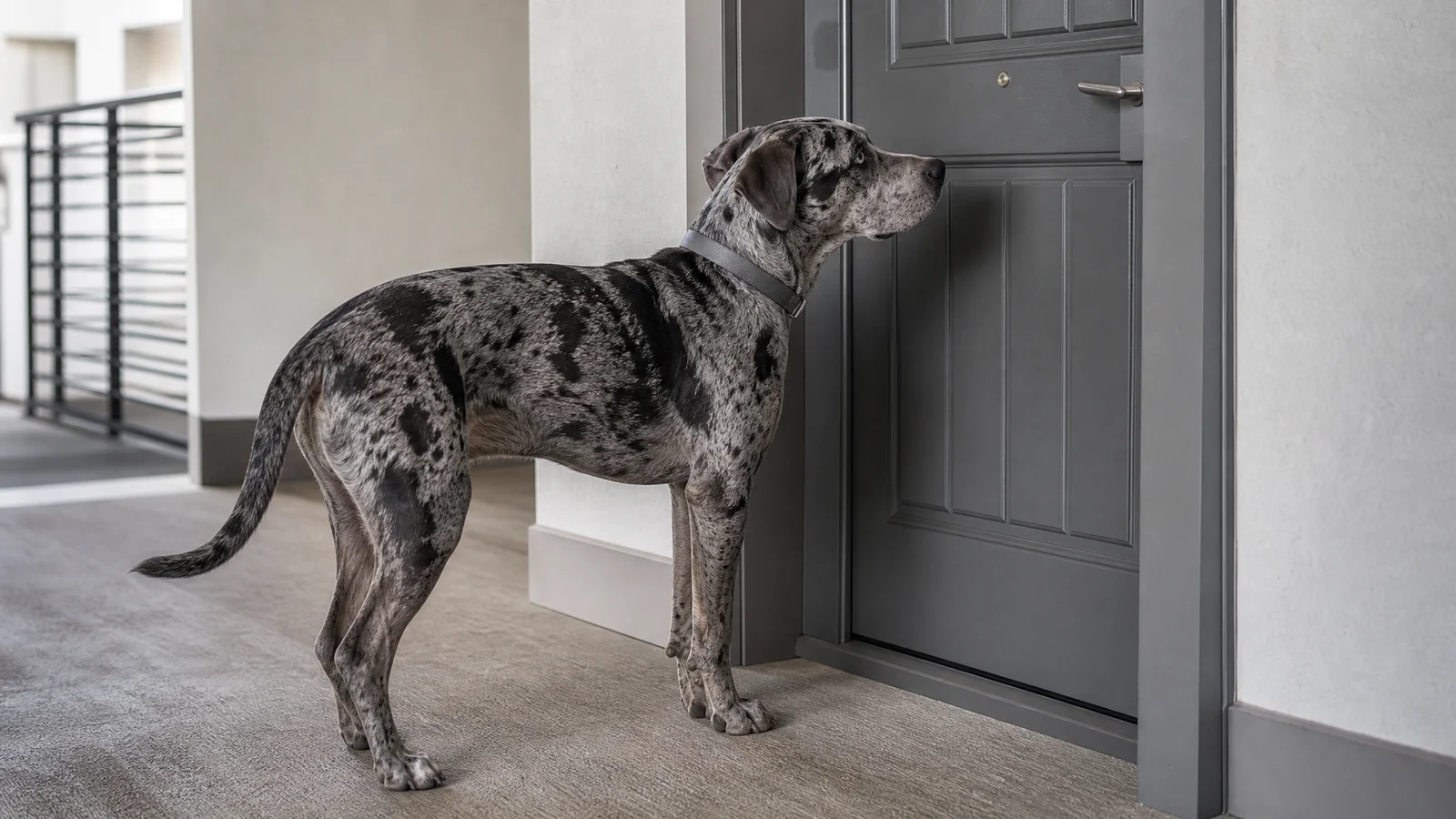
The breed's published ratings put young children, other dogs and strangers all at 3 of 5, which on that scale means supervision around kids and dogs and a middling openness to people. Those same notes say independence and territorial instincts make early socializing very important. Owners describe the same dog in livelier terms, as a loyal, watchful companion who treats a knock at the door as an event and a stranger on the landing as a question that needs an answer.
Handled well, that watchfulness becomes a dog who greets guests calmly and keeps a few good dog friends. Handled badly, it hardens into lunging and snarling and a household that quietly stops having visitors. Below, you'll find one hypothetical puppy followed from the first week to age two, including how to introduce children, strangers and other dogs and how to read worry or guarding early.
Socializing an Imagined Ten-Week Puppy, Two Bedrooms
Everything in this article follows one typical case: a ten-week-old Catahoula puppy arriving in a two-bedroom apartment where the adults work from home some days and a young niece visits on weekends. The choices the example owner makes come from what the breed is known for and what owners commonly report, so your own puppy will differ in the details.
Calm and neutral is the aim here, not a puppy who greets every person and dog with delight. The breed standard says it is not uncommon for Catahoulas to be aloof with strangers, so our example owner works toward a puppy who stays neutral, recovers quickly from surprises and glances back at the person holding the leash when something new appears. Friendliness is a bonus, and calm is the real target.
Daily Schedule as Socializing
There is an honest tension in the setup, because the breed needs room for a great deal of energy and is generally considered a poor fit for apartment life. The example owner answers that by treating the daily schedule as part of socializing, with long outings, mental work and a regular job, drawing on ideas from jobs and sports for Catahoulas. A tired, occupied puppy notices fewer small things and recovers faster from the ones they do notice.
Timing matters too. Catahoulas may work like an adult around 10 months but are not fully mature until 2 years, so the owner plans on a project that runs through most of that stretch. Regular vet visits start early and continue, and the vet decides when the puppy is ready for public places and unfamiliar dogs.
Week One Socializing Indoors Before Any Visitors
The first week is quiet on purpose. The puppy learns the layout, the routine and the sounds of apartment life, and visitors wait until a settle on the mat comes easily. Because Catahoulas are watchful by nature, a calm start gives that watchfulness a relaxed baseline to measure everything else against.
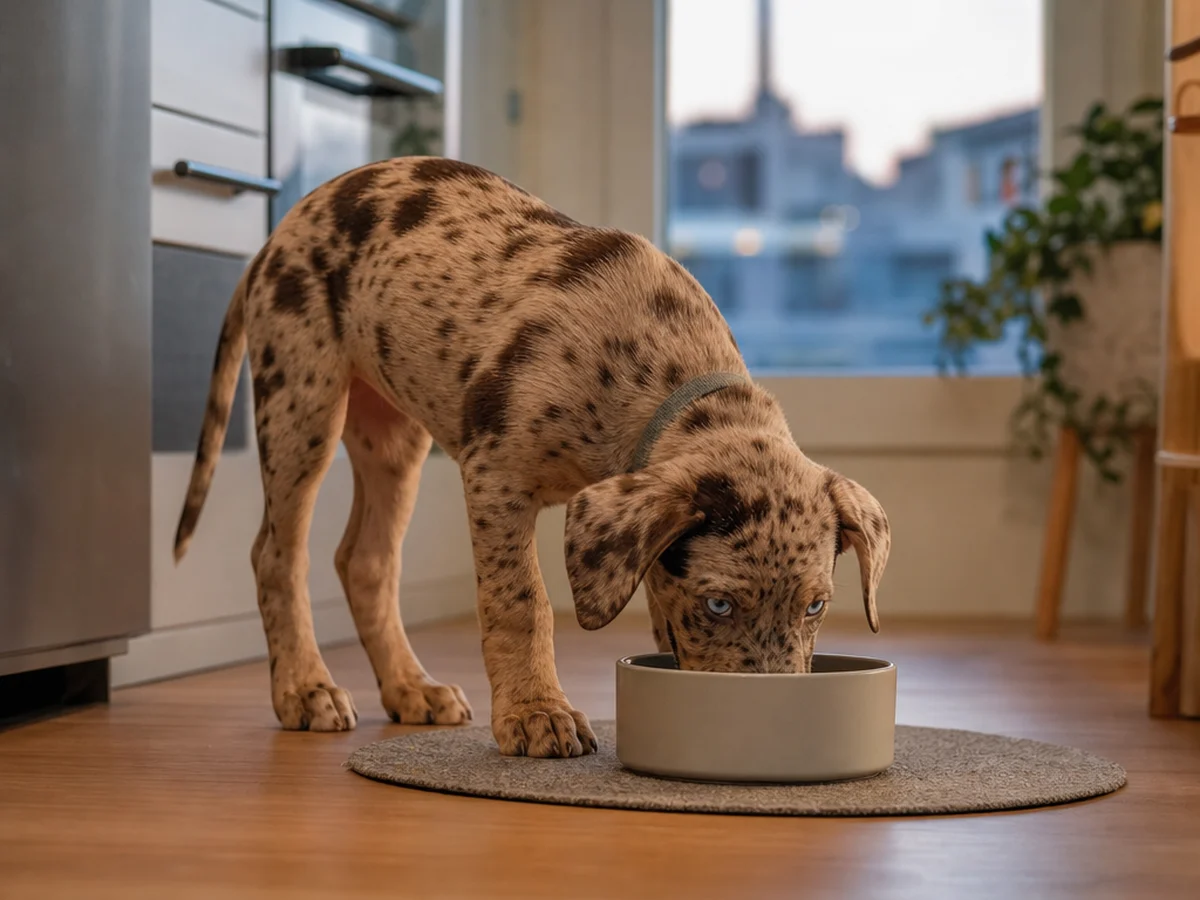
- Play recordings of doorbells, knocks and hallway voices at low volume while the puppy eats, and raise the volume over many days only while they stay loose and interested.
- Pair real building sounds, such as a neighbor's door or footsteps on the stairs, with a small treat the instant the puppy notices them, so the sound starts to predict something good.
- Handle paws, ears, mouth and collar for a few seconds at a time, rewarding every moment of stillness.
- Teach a mat and a down, because those become the answer to a knock later.
- End each session while the puppy is still keen, with rest in between.
None of this is exotic, and the simple principle that food, toys or praise make a rewarded action turn up more often is the whole engine. What is specific to this breed is the reason for the mat. Owners report that their Catahoulas tend to stay silent while lying down, so a down cued just before a trigger often prevents the barking instead of chasing it.
Watch the face and body while the sounds play. A soft mouth, a loose body and a willingness to eat mean you can carry on, while a frozen stare, a tucked tail or a refused treat means the sound is too loud or too close. Back up, make it easier, and the puppy will show you when they are ready for more.
How Should a Catahoula Leopard Dog Puppy Meet Kids?
Slowly, on the puppy's terms, and always with an adult watching. The breed scores 3 of 5 with young children on a scale where that number means with supervision, and owners' experience agrees. Some owners start early with the clear aim of raising a dog who is great with children, and many do end up with an affectionate, gentle companion, yet early work is a foundation and not a guarantee.
Before the niece's first visit, the example owner writes the rules down and shares them with the whole family.
- An adult watches the puppy and the child together, and the session ends when anyone gets tired or excited.
- Children sit on the floor or a chair and let the puppy approach, instead of reaching over the head, hugging or chasing.
- Treats are tossed gently or offered on a flat hand, so the puppy links children with good things.
- The puppy has a gate or pen to retreat to, and children never follow them in.
- Food, chews and toys are given while children are in another room.
The owner also learns the early signs of worry, which run from a stiff body, a hard stare and lip licking through yawning, turning away and freezing to, finally, a growl. Each one is the puppy asking for distance, and the right answer is to give it at once and end on a good note. A growl is useful information, so the owner calmly separates the two and thinks about what came before it.
Fast games need the most care. Owners report sudden bursts of prey drive in this breed, so running and squealing games stay away from the puppy until they can lie on the mat while children play nearby.
Strangers on Stairs With a Catahoula Leopard Dog
Apartment buildings put strangers closer than any yard would, on landings, in stairwells and in elevators. A watchful dog tends to treat narrow, echoing spaces as places where a decision is needed, so the owner's job is to make that decision for them. We have trained this breed for many years, and the pattern we keep coming back to is that the owner sets the tone and the dog follows.
In the hallway, the example owner stops at a distance where the puppy can still take treats, lets the person pass and feeds as they go by. The puppy is never required to greet anyone. Common advice says every friendly stranger should pet a puppy so they get used to people, but with an aloof breed that backfires, because the puppy learns that quiet warnings get ignored.
At the apartment door, a short routine replaces guesswork.
- Put the puppy on the mat or behind the gate before opening the door.
- Ask the guest to ignore the puppy and not reach toward them.
- Have the guest ask for a cue the puppy already knows, such as sit or down, and reward only calm behavior.
- Welcome the guest warmly where the puppy can see the welcome.
- Keep early visits short and end them before the puppy gets tense.
Owners report that this can turn a stranger-danger reaction into a calm greeting, because the puppy learns what to do when someone arrives and is not left to guard. The owner's welcome in step four matters more than the guest's friendliness. Many Catahoulas treat a visitor as family once the owners have clearly accepted that person, even when the first greeting at the door was rough.
Socializing With Other Dogs in Month Three
By month three, with the vet's go-ahead, the example owner begins meeting other dogs. The breed's rating with other dogs is also 3 of 5, so the plan favors a small circle of steady, polite dogs the puppy gets to know well. Quality of contact counts for more than quantity.
Starting With Walks
Meetings begin as parallel walks, with two dogs strolling side by side along separate paths at a comfortable distance while the owner rewards the puppy for checking in. The gap narrows over several outings only if both dogs stay loose, and sniffs are brief before everyone moves on. Leashes stay slack, and the owner ends the meeting while it is still going well.
Why the Dog Park Often Fails
Common advice sends every puppy to the dog park, and for this breed that is often the wrong lesson. Many Catahoulas do well with dogs they know but find a park too unpredictable, as if there were too many variables to manage. Growling at pushy play invitations and an occasional snap or nip at a nose are signs the setting is too much, not signs of a bad dog.
Early work also has limits. Some owners report a dog who seemed fine as a puppy turning against most other dogs at around a year and a half, despite plenty of exposure. The example owner expects that possibility, keeps friendships few and treats a dog who prefers their own company as a normal Catahoula.
Does Socializing Stop Territorial Wariness at Adolescence?
Not reliably, and it is kinder to hear that now. Early training and varied exposure do not guarantee a relaxed adult, and some owners report territorial behavior appearing after a few months at home, with snarling and lunging at people near the apartment. Others simply describe a dog who is very protective of their space, their ball and their family.
The useful way to read this is through worry. Guarding is typically based in anxiety, and that fits an adolescent who suddenly feels responsible for the home. The example owner stops asking whether the young dog is being rude and starts asking what they are worried about.
- Frost or block the window view that lets the dog rehearse barking at passersby all day.
- Increase distance from the trigger until the dog can take a treat, then reward calm at that distance.
- Cue a down on the mat before a known trigger, such as the knock or a dog passing the building.
- Trade toys and chews for treats instead of taking them, and let the dog eat in peace.
Progress can be slow, and that is normal with territorial wariness. A careful reward-based program may take months to show change, and a calmer environment with fewer triggers near the home can make the work easier, though wariness of strangers may not disappear entirely. Current evidence supports reward-based methods only for treating behavior problems, so any help you hire should work that way.
A sudden change in behavior deserves a vet visit first, since pain can change how a dog reacts. Our guide to common Catahoula behavior problems covers the instincts behind many of these patterns.
A Socialized Catahoula Leopard Dog at Two Years
At two years, our example dog has reached full maturity, and the result is a gentle, affectionate family companion who is still reserved with strangers. They greet regular visitors calmly once the owners have welcomed them, settle on the mat when the knock comes and ignore most hallway traffic. That is a real success, and it matches the affectionate, gentle and loyal companion the breed is meant to be.
The watchfulness has not gone away, and nobody should expect it to. The breed rates high for protective nature, so the dog will probably always notice who arrives and who passes the yard. Training changed what they do with that noticing.
Supervised practice never fully ends. Children still play with the dog under an adult's eye, new people are introduced through the owner's welcome, and the circle of canine friends stays small and familiar. Regular vet visits continue as well.
We specialize in this breed's behavior, and the lesson we would leave you with is simple. A capable, independent and territorial dog needs a dependable response to the world, so natural watchfulness has a calm outlet and does not turn into worry. Meet the need for exercise and work, keep the exposure gentle and the contacts few, and you get a loyal companion who stays watchful and reserved with strangers for life.
 BehaviorTerritorial and Protective: Guiding a Watchful Catahoula
 BehaviorClimbing, Jumping and Fence Manners for an Athletic Catahoula
 BehaviorWhy Does My Catahoula Nip and Herd People?